
30 strengths and areas of improvement examples at work
Read more Questions & Templates
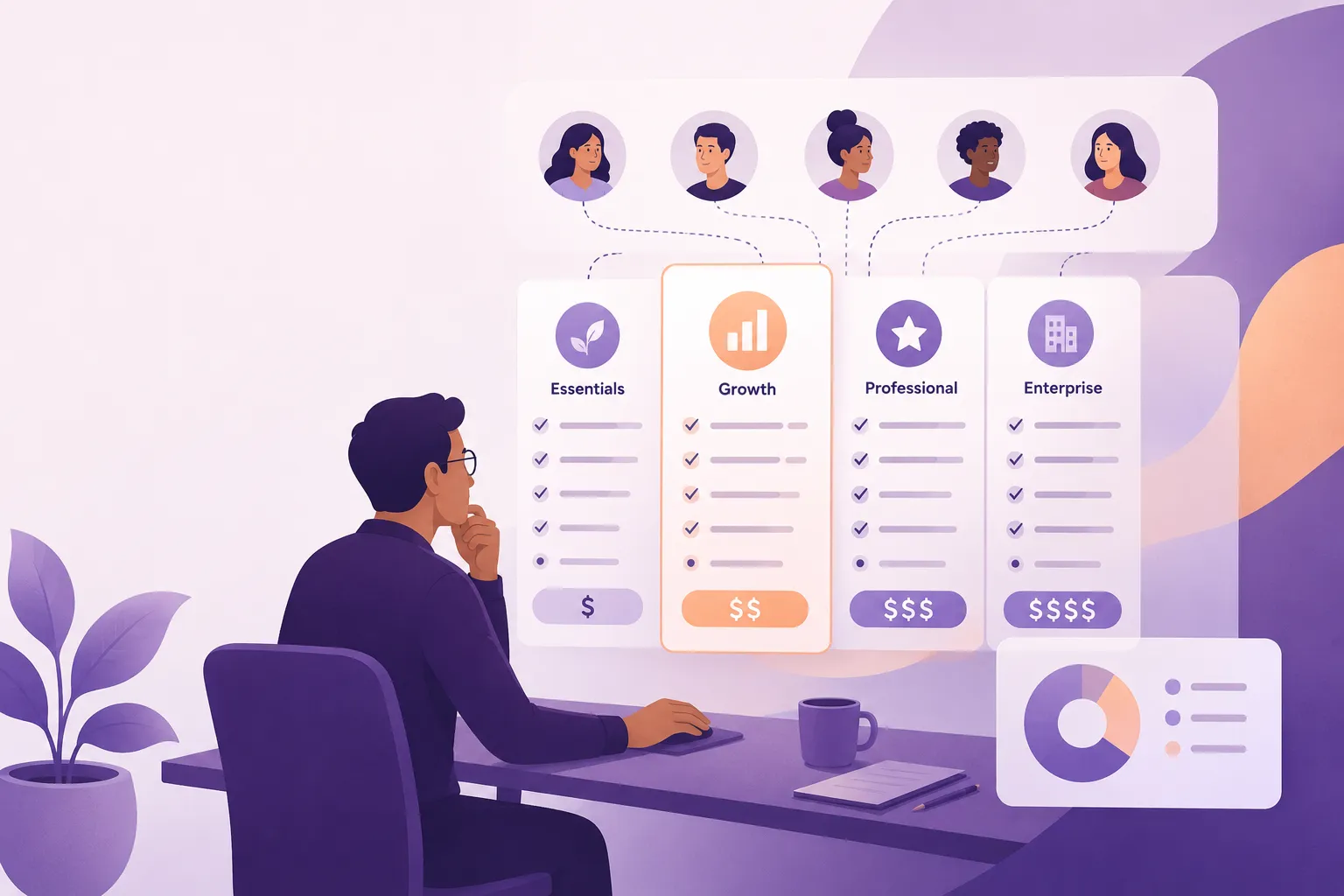
So how much does 360 feedback software cost? For a team of 30 to 200 people, somewhere between nothing and roughly $20 per user per month. That spread is real, and it isn’t arbitrary. It tracks what category of tool you’re buying, not how good the tool is. The cheapest options are focused 360 tools (or no-cost starter tiers within them); the most expensive are full performance management platforms that include 360 as one module of many. Most companies overpay by buying the wrong category, not by picking the wrong vendor inside the right one.
I run a focused 360 tool, so I’ll be transparent about where our number sits in the landscape below, and where the real trade-offs are.
This piece is for the buyer mid-evaluation. You’ve decided you need software. You’re either pricing it out for a CFO conversation or comparing vendor quotes that don’t quite add up. This is 360 degree feedback software pricing broken into three things: the realistic price tiers, how the pricing models actually work (and where they hide the real cost), and how to match your spend to your actual use case so you don’t overpay.
Key takeaways
- 360 feedback software at the SMB tier ranges from no-cost focused-tool starter plans to roughly $8 to $12 per user per month for paid focused tools, and $8 to $20 or more for full performance management platforms with 360 as one module.
- The category you pick matters more than the vendor you pick within it. A 30-person team buying Lattice for the 360 module is overpaying by a factor of three to five.
- Per-active-user pricing is usually cheaper than per-seat for occasional review rounds, more expensive for continuous use. Read the model before the headline number.
- Annual contracts and implementation fees are where vendor pricing pages quietly inflate the real cost. The “starts at $X per user” headline is rarely the year-one number you’ll actually pay.
- Match cost to use case, not to ambition. An annual 360 for a 30-person team is a starter-tier problem; a quarterly 360 plus reviews plus OKRs for a 200-person team is a platform problem. Most companies sit at the first end and shop at the second.
The realistic landscape for a team between 30 and 200 people falls into three categories. Knowing which one you belong in is more important than knowing the exact vendor.
Several focused 360 tools, including Lynxify, offer no-cost starter plans that cover the actual 360 mechanics: setting up rounds, inviting reviewers, collecting responses, generating summaries, and producing per-reviewee reports. The trade-off is usually a cap on something. Number of reviewees per period. Advanced features like custom criteria or SSO. Number of saved rounds in history. Specific limits vary by vendor.
The framing worth keeping: starter plans like this exist, they’re usable for real work, and they’re underused because most buyers assume “free” means trial. It often doesn’t. Lynxify Starter is one of these (no time limit, full core feature set), and there are other vendors with similar offerings worth comparing.
The word “free” covers several different arrangements at this tier, from a plan with no seat limit to a single free assessment that turns into a purchase. Free 360 feedback tools: what you get and what you don’t goes through each one and what it actually includes.
Roughly $8 to $12 per user per month for tools whose only job is structured 360 feedback. The price reflects narrow scope, which is often what a growing company actually needs. For most SMBs this is the affordable 360 feedback tier: a focused tool with real features and no platform tax. At this tier you typically get reminders, response aggregation, anonymity guarantees, AI-generated summaries, role-specific question sets, and reporting that doesn’t require a separate BI add-on.
Annual contracts at this tier exist but aren’t usually mandatory. Month-to-month is common. Implementation fees are rare or absent.
Roughly $8 to $20 or more per user per month for platforms that include 360 as one module alongside performance reviews, OKRs, engagement surveys, compensation modules, succession planning, and HRIS integration. The familiar names sit here: Lattice, Culture Amp, Leapsome, 15Five, and a handful of others.
Pricing at this tier is almost always an annual contract, often broken into starter / business / enterprise tiers, and frequently carries an implementation fee that doesn’t appear on the marketing site. The headline “starts at $X” rarely matches the all-in year-one number.
The reality: most teams between 30 and 100 people belong in Tier 1 or Tier 2. Most teams between 100 and 200 still belong in Tier 2 unless they explicitly want OKRs, compensation, and engagement on the same platform. The category mismatch (buying Tier 3 for a Tier 1 use case) is the single biggest cost driver in this space.
The category tier is half the picture. The model is the other half, and it’s where the headline number diverges from the contract number.
You pay on total headcount, regardless of who participates in any given round. Predictable, easy to budget, expensive if only some of your team will actually use it. Common at the platform tier and on enterprise plans of focused tools.
What to watch for: minimum seat counts. A vendor that says “$10 per user per month, minimum 50 users” is a $6,000-a-year tool whether your team has 20 people or 50.
You pay on people who actually log in, complete a round, or are included in a feedback round. Often cheaper than per-seat for occasional use (one annual 360), more expensive for continuous use (quarterly 360s plus ongoing review activity). Common at the focused-tool tier.
What to watch for: definitions of “active.” Some vendors count anyone who logs in once during the billing period; others count anyone included as a reviewer or reviewee. Read the definition before signing.
A bundle for “up to 50 users” or “up to 100 users” at a flat annual price. Tempting because it’s predictable. The trap is the cliff at the upper bound. The jump from “up to 50” to “up to 100” can be more than double, even though the marginal value of users 51 through 100 isn’t.
The big platforms list a starting per-user price, but the 360 module, advanced reporting, the integrations you need, SSO above the lowest tier, and API access are often separate line items. The headline price and the contract price diverge sharply at this tier. It’s not deceptive so much as standard industry practice, and you should expect it.
A flat fee charged at contract start for onboarding, training, and setup. Common at the platform tier. The realistic range at SMB plans is roughly $2,000 to $15,000, depending on team size and complexity, though it varies sharply by vendor. Almost unheard of at the focused-tool tier.
Implementation fees are usually negotiable, especially on the smaller end of the platform tier. Ask.
Most platform-tier vendors require annual contracts paid upfront or quarterly. Most focused-tool vendors offer month-to-month. The friction matters more than the discount: a free trial that quietly becomes an annual contract is a fundamentally different commitment than a true month-to-month relationship, even when the headline price is the same.
The pattern across all of these: the headline price on the marketing page rarely matches what shows up in the quote. The fix is a single question, asked in the first sales call: “what’s the all-in year-one cost for a team my size, including implementation, the modules I actually need, and any minimum-seat requirements?”
The framework is simple: match cost to use case, not to ambition. Your real 360 review cost is a function of how often you run one and for how many people, not the sticker price on a per-seat line.
30-person team running an annual 360, no other formal review process. Tier 1 (starter plan). Anything more is overspending. Pick a focused tool’s starter plan, run the round, see how it goes. If you outgrow the cap within 18 months, you’ll know.
50 to 100 person team, semi-annual 360s plus structured 1:1s, no OKRs or compensation in the same tool. Tier 2 (paid focused tool). Mid-range of the focused-tool band. Fully loaded annual cost in the $5,000 to $12,000 range, which is roughly a tenth of what the platform tier would cost for the same team. The advisory guide on what 360 software actually needs to do covers the criteria for picking inside this tier.
100 to 200 person team, quarterly 360s, performance reviews, and OKRs all on one platform. This is where a full platform starts to earn its place, and where you should expect $20,000 to $50,000 a year fully loaded. Pick by fit, not by feature checklist. The case against performance management software for companies under 100 covers the inverse: when the platform tier is the wrong upgrade.
200+ person team with complex performance plus engagement plus compensation plus learning. Platform tier purchase, almost certainly. At this scale the platform tax is real but justified by the alternative (managing five separate tools that don’t talk to each other).
The cheapest mistake on this scale is buying one tier too high. The most expensive mistake is buying two tiers too high, which the platform-tier vendors are very good at convincing growing teams to do.
A few close-reading rules that save weeks of evaluation, whether the product is marketed as 360 review software, 360 degree feedback software, 360 evaluation software, or a full performance management platform.
“Contact us” pricing usually means $20 or more per user with an annual contract and an implementation fee. It’s worth asking, but expect the higher end of the platform range.
“Starts at $X per user” rarely matches the real number. The starter tier is often the trial tier or is missing the features you actually need (like 360 itself). Always ask for the price of the tier that includes 360 specifically.
The lowest-priced platform tier often excludes 360. It’s a customer-acquisition feature gated behind a higher plan. Check which tier includes 360 before celebrating the headline price.
Negotiate the annual prepay discount. Annual prepay typically saves 10 to 20 percent on the monthly equivalent. Multi-year deals save more but lock you in. First-year discounts exist but reset at renewal; budget for the renewal price, not the introductory one.
Free trials at the platform tier are usually 14 days and sales-assisted. No-cost starter plans at the focused-tool tier are usually self-serve and have no time limit. They’re different products of marketing language, not different versions of the same thing.
The reality: vendor pricing pages are designed to start a sales conversation, not finish one. The cheapest way to evaluate a tool at this stage is to run an actual round on a starter plan and see what happens. If you can’t do that at all, the vendor has chosen friction as a strategy. That’s a data point too.
I run Lynxify. The Starter plan is free, includes the full 360 feedback feature set, and has no time limit. If after reading the above you think your team is at the focused-tool stage, start your first 360 in Lynxify. Full pricing details, including what sits above the Starter plan and when it makes sense to move up, are at Lynxify pricing.
If you think you’re at the platform stage, this article isn’t for you, and the candid comparison of 360 feedback software for small companies names the realistic options for that tier. If you’re comparing under the broader “performance review software” label, choosing a performance review tool at your size covers that buyer’s framework. Either way: don’t buy the category above what you need.
How much does 360 feedback software cost per user?
For focused 360 tools, roughly $8 to $12 per user per month at the paid tier, with no-cost starter plans available below that. For full performance management platforms that include 360 as one module, roughly $8 to $20 or more per user per month, often with annual contracts and an implementation fee. The per-user number is only half the picture; the contract terms and what’s included in each tier matter as much.
Is there 360 feedback software that’s actually usable at no cost?
Yes. Several focused 360 tools, including Lynxify, offer no-cost starter plans that cover the real 360 mechanics: rounds, reviewers, anonymity, summaries, and reports. The caps are usually on volume (number of reviewees per period or rounds in history) or on advanced features (custom criteria, SSO). For a small team running annual or semi-annual 360s, a starter plan often does the entire job.
Why is Lattice’s 360 module more expensive than focused 360 tools?
Lattice is a full performance management platform. The 360 module is one feature alongside performance reviews, OKRs, engagement, and other modules. You’re paying for the whole platform, not just the 360. If 360 is the only thing you need, that’s a category mismatch and you’ll pay roughly three to five times what a focused tool would cost. Check Lattice.com for current pricing details, since their tier structure changes periodically.
How much should a 50-person company pay for 360 feedback software?
If you’re running semi-annual or annual 360s with no other performance modules, a paid focused tool at roughly $5,000 to $12,000 a year fully loaded is the right range. A no-cost starter plan may also be enough at this team size, depending on round frequency. Paying $30,000 or more a year for a platform-tier tool to do what amounts to a 360 round is overbuying by a category.
Do 360 feedback tools require an annual contract?
Platform-tier tools almost always require an annual contract paid upfront or quarterly. Focused 360 tools typically offer month-to-month, with annual discounts available if you want them. If a vendor is pushing an annual contract for what is essentially a 360-only purchase, ask why, and ask if month-to-month is available at a slightly higher rate. It often is, and the optionality is usually worth the small premium.
Is 360 feedback software worth the cost for a small team?
Only if it removes work you’re actually doing. For a team running one or two 360s a year, a no-cost starter plan or a shared document is usually worth more than a paid tool, because the work the software removes (chasing responses, aggregating, synthesising) is still small at that volume. The math flips once you’re running rounds for six or more people regularly: the synthesis time a focused tool saves starts to exceed its price. Worth it is a function of frequency and headcount, not the sticker price.
Dmytro Shtapauk
Practical tips and experience from top-notch experts