
Free 360 feedback tools: what you get and what you don't
Read more Tool Selection

A new hire joins the team and within two weeks, their manager has already formed an opinion: this person is either “a great communicator” or “a bit slow to get going.” Neither read is quite right. What the manager is actually reacting to is that person’s work style, specifically their pace (how quickly they move from idea to action) and their focus (whether their attention goes first to the task or to the people around it). Those two things, more than almost anything else, decide whether a working relationship feels easy or feels like friction.
Most management advice skips straight past this. It talks about communication styles, or leadership styles, or personality types, all useful in their own way, but none of them name the specific thing that actually causes the daily friction: two people moving at different speeds, or paying attention to different things, without either one realizing that’s what’s actually happening.
Key Takeaways
- A work style is about pace (how fast someone decides and moves) and focus (whether their attention goes to the task or the people), not a fixed personality type.
- Most day-to-day management friction traces back to a mismatch on one of these two axes, not to a difference in skill or effort.
- Four reference styles, Driver, Motivator, Analyst and Connector, describe the combinations, but most people are a blend, not a pure type.
- Knowing a report’s work style changes how you delegate, how you deliver feedback, and how you read their silence in a meeting.
- It’s a starting point for working with someone, not a label to file them under.
Strip away the frameworks and personality tests, and a work style comes down to two independent questions.
Pace: how quickly does this person decide and act? Someone fast-paced would rather decide now and adjust later than wait for more certainty. They’re energized by momentum and get visibly impatient when something stalls. Someone steady-paced wants to think it through, values a consistent rhythm, and gets uneasy when a plan changes without warning. Neither is better. Fast pace ships things and creates momentum; it also skips steps. Steady pace catches what fast pace misses; it also moves slower than a deadline sometimes allows.
Focus: where does their attention go first? Someone task-focused is oriented to the work itself, quality, logic, getting it right. Someone people-focused is oriented to the humans doing the work, morale, relationships, how a decision actually lands. Again, neither is better. Task focus keeps standards high and catches errors. People focus keeps a team functional long enough to actually finish the work.
Put those two axes together and you get a map, not a label. Most people don’t sit in a corner of it, they sit somewhere between two corners, and the pull they feel between those two is usually more informative than whichever single word gets used to describe them.
Naming the extremes makes the axes concrete: these are reference points for describing the pull between corners, not boxes to sort people into.
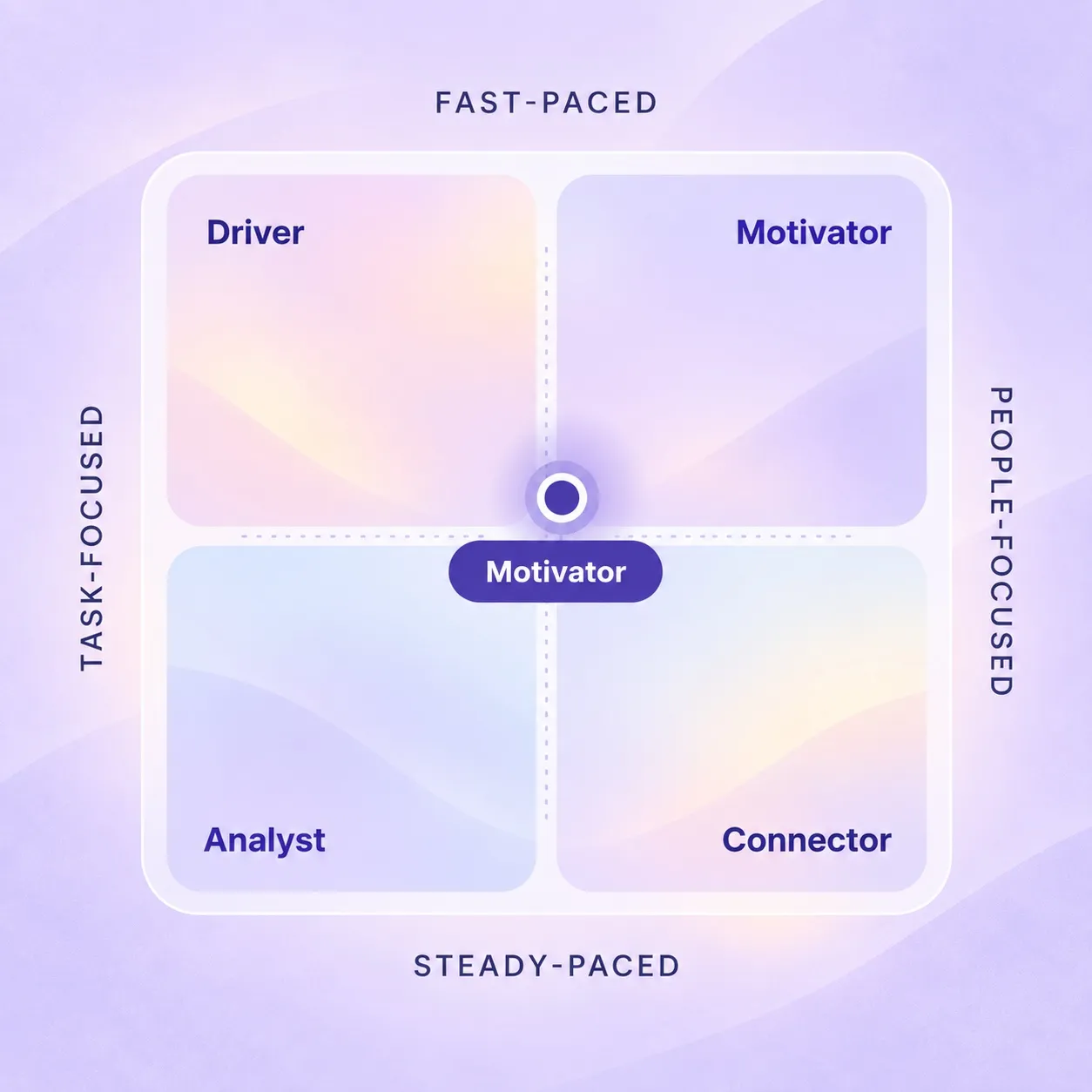
Driver (fast pace, task focus): direct and results-first, would rather settle something today than let it drift. Closes things others leave open, and their directness can land harder than they intend.
Motivator (fast pace, people focus): upbeat and persuasive, good at getting a stuck room moving again. The trade-off shows up in follow-through, since momentum is natural for this style and the quieter, later details are not.
Analyst (steady pace, task focus): careful and precise, would rather be right than fast. Catches the assumption everyone else skipped, and their quiet can get mistaken for agreement when it isn’t.
Connector (steady pace, people focus): warm and unhurried, keeps a team together while it works. Patient enough that people open up to them, and prone to absorbing things they should hand back.
Most real people are a blend of two neighboring styles rather than a pure corner, and the blend usually tells you more than the label does.
Understanding your own work style is mildly interesting. Understanding your report’s work style changes how you actually manage them.
A fast-paced manager giving feedback to a steady-paced report might read their thoughtful pause as resistance, when it’s actually the report doing exactly what makes them good at their job: thinking before responding. A task-focused manager might hand a people-focused report a spreadsheet and a deadline, when what would have gotten a faster result was five minutes explaining why the work matters to the people it affects.
This is the same idea underneath building a feedback culture: the tool doesn’t do the relational work, naming what’s actually happening between two people does. None of this is about ability. A fast decider and a careful checker can both be excellent at their jobs and still create real friction for each other, since the friction comes from mismatched expectations for how work should move and get discussed, not from a gap in competence. Naming that mismatch out loud, “I tend to decide fast and you tend to want more time, so let’s agree on a checkpoint instead of me assuming silence means agreement,” does more for a working relationship than any generic advice about communication styles.
The most practical use of this isn’t a personality workshop, it’s a shared vocabulary. A team that can say “I’m reading this as more people-focused than you are” instead of “you don’t seem to care about the deadline” is having a much more productive conversation.
A simple way to start: have everyone on the team take a short assessment and compare placements together, rather than debating it in the abstract. Lynxify.me built a free Work Style Quiz for exactly this: fifty short statements, about 8 to 10 minutes, and a placement on both axes along with the trade-offs that come with it. It’s a lighter, faster way to get the same starting conversation a longer personality assessment is trying to produce.
One placement is a guess about one person. Four people giving the same kind of read, peers, a manager, and self-assessment, is closer to a pattern you can actually act on. That’s the same principle behind running structured multi-rater feedback rather than relying on one manager’s read of someone’s performance.
It’s worth being direct about the limits here, since it’s easy to overreach with any framework like this. A work style describes a tendency, not a fixed identity or a ceiling. It’s not an excuse either: “that’s just my style” doesn’t justify blowing past a deadline or steamrolling a quieter teammate. And it isn’t a replacement for actually talking to someone about how they work best; it’s a faster way into that conversation.
The manager who learns to spot pace and focus isn’t getting a shortcut around understanding their team. They’re getting a name for something they were already half-noticing, and a name is usually what turns a vague friction into something you can actually work with.
Dmytro Shtapauk
Practical tips and experience from top-notch experts