
AI in performance reviews: what an AI summary can and can't do
Read more Performance Reviews

A good 360 feedback report shows, for each competency, how other people rated the person next to how they rated themselves, how far apart those ratings are, and the comments behind the scores. On top of that, it names two or three strengths and two or three growth areas so the reader knows where to start.
Most sample reports online show those sections without explaining them, and most guides to reading a 360 report assume a leader with twenty raters split into neat groups. At a company of 50 people, the person in the report usually has five raters: a manager, a few peers and maybe two direct reports. With five, you read a report differently.
This article covers what a 360 feedback report should contain, what it should leave out, how to read one when the rater group is small, how anonymity works in the report, and a real example, section by section.
Key takeaways
- A useful 360 feedback report has six parts: a short summary of strengths and growth areas, self vs others per competency, the spread of ratings, comments next to the scores, per-question detail when enough people answered, and an optional written summary kept apart from the raters’ words.
- With five raters, one person can move an average by half a point. Read the spread before you trust the average.
- Look for gaps between self-rating and others’ ratings that several raters share. A gap created by a single rater isn’t a pattern.
- A report should leave out an overall score, a ranking against colleagues, and per-question detail for groups too small to stay anonymous.
- Read the comments first, then the numbers, and pick two things to talk about.
These six parts work as a template, whether you’re comparing tools or building a 360 degree feedback report in a spreadsheet.
1. A short summary of strengths and growth areas. Two or three of each, at the top. Most people read the first screen of a report and skim the rest, so the summary decides what they remember. It should come from the ratings, with the highest and lowest competencies, and it should say how the self-rating compares.
2. Self vs others for each competency. The person’s own rating next to the average of everyone else’s. This is often the most useful part of the whole report, because the distance between the two is something the person can’t see on their own. I’ve written more about why self-ratings and others’ ratings disagree.
3. The spread of ratings. How many people gave a 5, a 4, a 2. An average without the spread hides the most interesting thing in the data: whether people agree.
4. Comments next to the scores. A 3 for communication is a number. “Decisions on our joint project get made in meetings I’m not in” is something the person can act on. Comments belong next to the competency they explain, and a separate page of all comments at the end doesn’t do that job.
5. Per-question detail, when the group is big enough. Within a competency, which questions scored high and which scored low. This is where the specific behaviour shows up, and it’s also where anonymity breaks first, so it should appear only when enough people answered.
6. A written summary, kept apart. If the report includes a summary written by a manager or by AI, it should sit in its own section, clearly separate from the raters’ words. Otherwise nobody can tell later which sentence was evidence and which was interpretation.
The comments tell you why a score is what it is. Read them first and the numbers start to make sense. If you start with the numbers, you’ll form an opinion before you know what’s behind them.
Imagine a report where three peers rate “collaboration” a 5 and two rate it a 2. The average is 3.8, a number nobody actually gave. The real story is a split: the person collaborates well with one part of the team and hardly at all with the other. The comments usually say which part.
With five raters, one person moving a score from 4 to 2 shifts the average by 0.4 points. So treat any difference smaller than about half a point between two competencies as noise. I made the longer case for this in the bias problem in 360 reviews, where averaging is the main way bias hides.
My rule of thumb: a gap of about one point on a five-point scale between the self-rating and the others’ average is worth talking about, as long as most raters lean the same way. If the gap exists because one rater gave a 1, it tells you about that one working relationship and nothing more.
Both directions matter. Rating yourself higher than others do is the familiar blind spot. Rating yourself lower is a hidden strength, and it’s often the easier conversation to start with.
A report with eight competencies gives you eight things to discuss. Choose one strength to keep using and one growth area to work on. A person can act on two points; a list of ten becomes a document nobody opens again.
Anonymity is decided before the round starts, and the report is where it either holds or breaks. Three rules make it hold:
A common situation: a team lead with two direct reports gets an “anonymous” upward score of 2 for listening. Both direct reports know the team lead will guess, and from then on both write carefully. The report was technically anonymous and practically useless. There’s more on this in anonymous feedback at a small company.
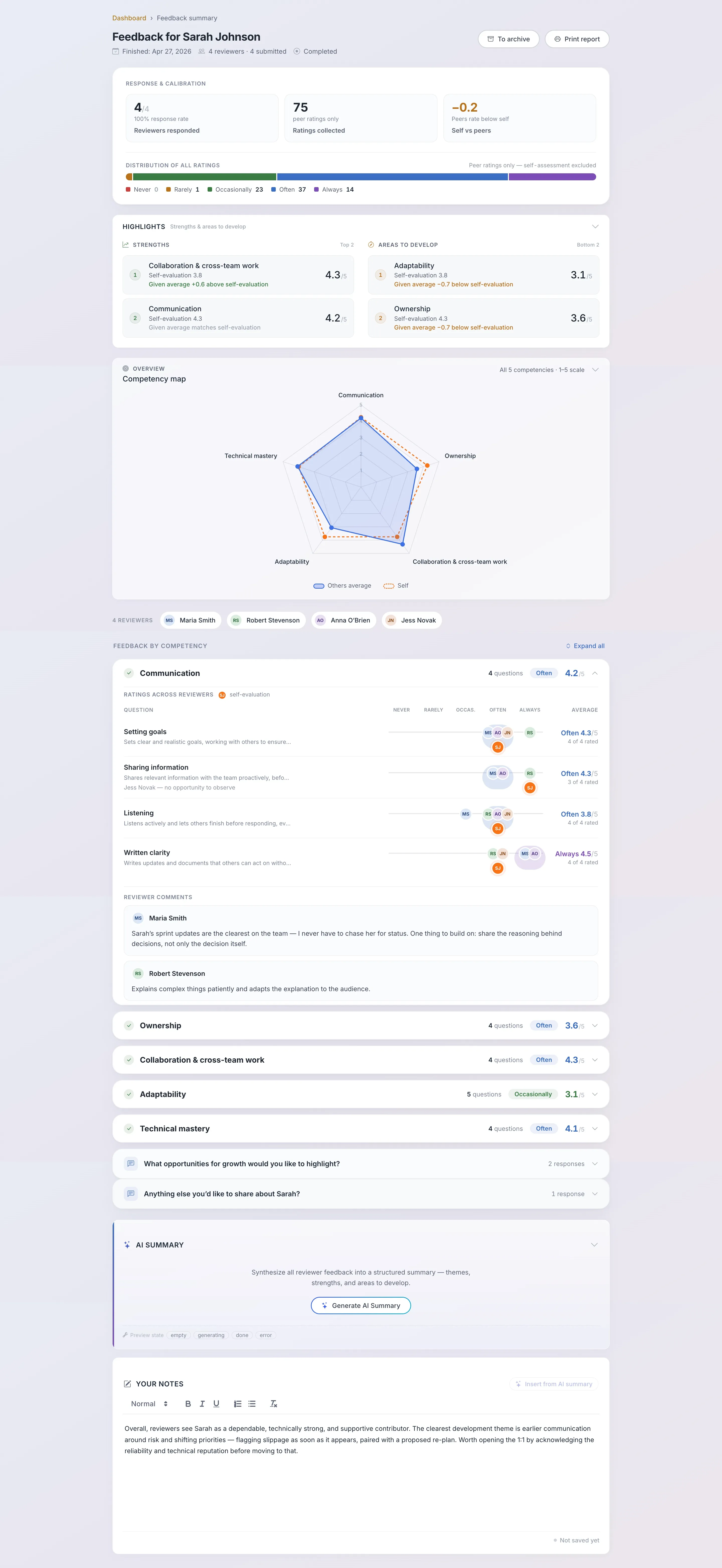
Here is a sample report from Lynxify.me, with the six parts put together, as one example you can hold against the list above.
You can see the feature page for the Lynxify.me report for the details.
A report is preparation for a conversation, and the conversation is where feedback becomes useful or doesn’t. Bring the summary, the two points you chose and one or two comments that explain them, then follow how to deliver 360 feedback results without turning it into a verdict.
A 360 feedback report doesn’t need to be clever. It needs to show who agrees with whom, keep the comments next to the scores, and protect the people who answered. The hard work happens before it (choosing raters who’ve actually seen the work) and after it (one candid conversation about two things).
If you want a report built this way without assembling it in a spreadsheet, you can start free with Lynxify.me and run your first round for one person. Sign in with Google or Microsoft, with no annual contract.
What should a 360 feedback report include?
A short summary of two or three strengths and growth areas, the person’s self-rating next to how others rated them for each competency, the spread of those ratings, the written comments next to the scores, and per-question detail when enough people answered to keep it anonymous. A written summary, if there is one, should sit apart from the raters’ own words.
How do you read a 360 feedback report?
Start with the comments, then look at the scores. For each competency, check how spread out the ratings are before you trust the average, and look for gaps between the self-rating and others’ ratings that several raters share. Then pick two things to talk about. With five raters, one person can move an average by half a point, so a single number is never the whole story.
How many raters do you need for a reliable 360 report?
For a person at a small company, four to six raters is a realistic range: the manager, two or three peers and, for a manager, a few direct reports. Fewer than three in a group makes anonymity hard to keep and lets one rater dominate the result. More raters only help if they work with the person closely enough to answer from what they’ve seen.
Is a 360 feedback report anonymous?
It can be. In an anonymous round, a good report shows comments and per-question scores only when enough people in a group answered, so nobody can work out who said what by elimination. In a group of two peers, true anonymity isn’t possible, and the report should say so instead of pretending.
Can I see an example of a 360 feedback report?
Yes. This article walks through the Lynxify.me report section by section: the strengths and growth areas at the top, the radar chart with the self-rating drawn over everyone else’s average, and the feedback by competency with each comment next to its score.
Dmytro Shtapauk
Practical tips and experience from top-notch experts