
Free 360 feedback tools: what you get and what you don't
Read more Tool Selection

A useful strength or area of improvement names something the person did, where it happened, and what it caused. “Great communicator” and “needs better time management” name nothing, which is why they get read, nodded at, and forgotten by Friday. Below are 30 strengths and areas of improvement examples at work, each written the way it should appear in a 360 or a performance review, and grouped under the three competencies most feedback forms end up measuring anyway.
Most lists like this miss one pattern: a lot of areas of improvement turn out to be a strength used in the wrong place or turned up too far. The person who always has the answer is also the person the room has stopped challenging. Once you see the pairing, growth areas get easier to write and much easier to hear.
If you’re writing feedback about a colleague, adapt the sentences below to what you actually saw. If you’re writing your own self-assessment, skip ahead to the section on 3 key strengths and 3 areas of improvement.
Key Takeaways
- A strength or area of improvement is useful when it names a behaviour, the moment it showed up, and its effect. A trait label (“great communicator”, “needs better time management”) gives the person nothing to repeat or change.
- Many real areas of improvement are strengths overdone: decisive turns into deciding for everyone, thorough turns into shipping late, helpful turns into never saying no. Writing them as a pair makes the growth area far easier to accept.
- When some raters praise a behaviour and others flag it in the same 360, you are usually looking at one behaviour seen from two seats, which is more useful than contradictory feedback.
- One to three areas of improvement is the useful maximum. A list of seven produces no change at all.
- For a self-assessment, pick strengths other people would recognise and areas you’re already working on, each with the first step you’ve taken.
Every example below has the same three parts: the behaviour, the moment it showed up, and the effect it had. Areas of improvement get a fourth part, the one change that would help. Leave any of them out and the sentence slides back into a label.
The vocabulary varies more than the idea does. Areas of improvement, areas for improvement, growth areas, development areas, and weaknesses all describe the same thing at different temperatures. “Weakness” is the coldest and the most likely to put someone on the defensive, while “growth area” is the warmest. Both “areas of improvement” and “areas for improvement” are correct, so use whichever your review form already uses.
One thing this list skips on purpose is the rewrite drill, where you take a vague line and make it specific. If that’s what you need, weak and strong 360 feedback examples side by side walks through it for peers, managers, and direct reports. This piece is a catalogue instead: named strengths and named areas of improvement, each with a sentence you can adapt in under a minute.
The examples are grouped under Collaboration & Communication, Ownership & Delivery, and Skill & Problem Solving. Those are the three starter competencies every new Lynxify.me account comes with, and between them they cover most of the strengths and areas of improvement at work that come up in a 360.
1. Writes the pre-read. Before a decision meeting, they send a short summary with the options and their recommendation. “Your pre-read before the pricing review meant everyone arrived with an opinion, and we decided in 30 minutes instead of booking a second meeting.”
2. Disagrees in the room. They raise objections during the discussion, while the decision is still open. “When you pushed back on the launch date in planning, it surfaced the QA gap while there was still time to move the date.”
3. Makes other people’s work visible. They credit specific people for specific work in public. “In the release notes you named the two people who fixed the migration, and both of them mentioned it to me the next day.”
4. Asks the question others are holding back. “On the vendor call you asked what happens if the integration fails, which was the question three of us had and nobody had said out loud.”
5. Updates before anyone has to ask. “I haven’t had to chase you for a status update on the onboarding project once, because your Friday note always lands first.”
6. Makes decisions in private messages. “The switch to the new analytics tool was agreed in a direct message, so the rest of the team found out when their dashboards broke. Posting decisions in the team channel would keep everyone on the same page.”
7. Buries the ask. This is the overdone version of #5. “Your weekly updates are thorough, but the one thing you need from me usually sits in the fifth paragraph. Putting the ask in the first line would get you a faster answer.”
8. Goes quiet under pressure. “During last month’s outage we heard nothing from you for three hours, even though you were the one fixing it. A two-line update every 30 minutes would have stopped the escalations.”
9. Keeps debating after the decision. This is the overdone version of #2. “In design reviews you often keep arguing after a call is made, and fewer people raise ideas when you’re in the room. Saying ‘I disagree, but let’s go’ once the decision is made would keep your pushback valuable.”
10. Shares concerns only when asked. “You spotted the problems in the proposal before anyone else, and you mentioned them only when I asked directly, two days before the deadline. Raising them as soon as you see them would give the team time to act.”
11. Flags risk early. “You called the payments project at-risk three weeks before the deadline, which gave us time to cut scope instead of slipping the date.”
12. Closes the loop. “Every customer escalation you picked up this quarter ended with a note back to support saying what was fixed, so nobody had to ask twice.”
13. Scopes down to ship. “When the reporting feature was running long, you proposed shipping the export first and the charts later, which got customers the part they were asking for a month earlier.”
14. Owns the miss. “In the retro for the missed invoice run you opened with what you would have done differently, which made it easier for everyone else to do the same.”
15. Picks up work nobody owns. “Nobody owned the flaky test suite until you took it on, and our deploys have been green for six weeks since.”
16. Says yes to everything. This is the overdone version of #15. “You took on three side projects this quarter on top of the roadmap, and the roadmap work is where the delays showed up. Checking with me before saying yes to a fourth would help us both protect it.”
17. Stays “almost done” for weeks. “The migration was reported as 90% done in four standups in a row. Breaking it into smaller pieces, each with its own finish line, would make the real status visible.”
18. Relies on heroics. “The last two releases went out because you stayed late fixing them, which I appreciate and don’t want the team to depend on. Writing a release checklist would let someone else catch those issues earlier in the week.”
19. Surprises people with deadlines. “Twice this quarter I learned a deadline would slip on the day it was due. Telling me when you first suspect it, even if you’re unsure, gives us options.”
20. Hands off without context. “When the client account moved to a new owner there was no handover note, and the client had to explain their contract terms again. A one-page handover would have saved that first awkward call.”
21. Finds the root cause. “When sign-ups dropped, you traced it to the email verification change instead of tweaking the landing page, which is why the fix held.”
22. Makes hard things simple for others. “Your one-page explanation of the new pricing model is still what the sales team sends to customers, three months later.”
23. Learns a new area fast. “You had never worked on billing before March, and by May you were the person the team asked about it.”
24. Knows when good enough is enough. “On the internal dashboard you stopped at the version that answered the three questions leadership had, which saved weeks of polish nobody needed.”
25. Teaches while doing. “You pair with newer engineers on the tricky tickets instead of taking them yourself, and both people you paired with this quarter now handle those tickets alone.”
26. Always has the answer. This is the overdone version of #21. “You usually have the right answer in technical discussions, and the team has started waiting for yours before offering their own. Asking two other people for their view before you give yours would bring more ideas into the room.”
27. Stays stuck alone too long. “You spent four days on the caching bug before mentioning it, and the fix took an hour once two of us looked. Asking for help after half a day of being stuck would save most of that time.”
28. Polishes past the point of value. This is the reverse of #24. “The onboarding redesign was excellent, and it shipped five weeks late because of polish on screens few users see. Agreeing on what ‘done’ means before starting would help.”
29. Jumps to solutions. “In the churn discussion you proposed a discount programme before we had agreed on why customers were leaving. Spending the first meeting on the problem would make your solutions much easier to back.”
30. Keeps knowledge in their head. This is the overdone version of #23. “While you were on leave, the team couldn’t deploy the reporting service because the steps only exist in your memory. A short runbook would let you take a holiday without checking your phone.”
Six of the thirty examples above are marked as the overdone or reversed version of a strength, and that ratio is closer to reality than most lists admit. People rarely have a random collection of flaws. More often they have a few habits that work well and a few situations where those same habits cost more than they give.
| Strength | Overdone, it becomes |
|---|---|
| Decisive, makes calls quickly | Decides before others have had a say |
| Thorough, high standards | Ships late, polishes what nobody uses |
| Helpful, picks up anything | Says yes to everything, core work slips |
| Direct, disagrees openly | Keeps debating after the decision |
| Expert, has the answer | The room stops offering ideas |
| Detailed in updates | The one thing that matters gets buried |
This pattern explains one of the most confusing things about reading a 360. Imagine a senior engineer whose results come back with “decisive, unblocks the team fast” from two peers and “decisions happen before I’ve had a say” from a direct report. It’s tempting to call that mixed feedback and average it out. Both comments describe the same behaviour from different seats: the peers get the speed, and the direct report pays for it.
The way to write it is to name the strength first and then the context where it tips over. “You make calls quickly, which unblocks the team. On decisions that change your reports’ work, asking for their view first would keep that speed from costing their buy-in.”
The person gets to keep the habit that made them good, and the change is small and specific to one situation. That is a much easier thing to agree to than “stop being so controlling,” which is what the direct report may have been tempted to write.
The “3 key strengths and 3 areas of improvement” format shows up in self-assessments, development plans, and a lot of interviews. For the self-assessment part of a 360, three rules do most of the work.
Here’s a hypothetical example. Imagine a product manager, two years into the role, writing their self-assessment:
Strengths
Areas of improvement
When the 360 results come back, put your list next to what your raters wrote. A strength you claimed that nobody mentioned, or a growth area three people raised that you left out, is often the most useful line in the whole report. The gap between how you rate yourself and how others do is worth reading before that conversation.
If the same question comes up in a job interview, the structure holds. Lead with the evidence behind your strengths, and keep the areas of improvement to ones where you can already show progress, since an interviewer is weighing where you’re heading as much as where you are.
A list like this one makes it tempting to hand someone six growth areas because each of them seems fair. Nobody changes six things in a quarter. They pick the one that stings most, argue with it, and the rest quietly disappear. Pick the one or two that matter most for the person’s role right now, and let the others go, even the true ones.
Picture a manager preparing a review for a support lead whose 360 raised seven different development points. They choose one, slow updates during escalations, because three raters mentioned it independently and it reaches customers directly. A single commitment like that has a real chance of sticking, and seven competing ones don’t.
That’s also why the report in Lynxify.me opens with a short set of top strengths and growth areas, ranked by the peer-average rating for each competency, with the person’s own self-rating shown alongside. The written comments sit under each competency, so every callout comes with the moments behind it. 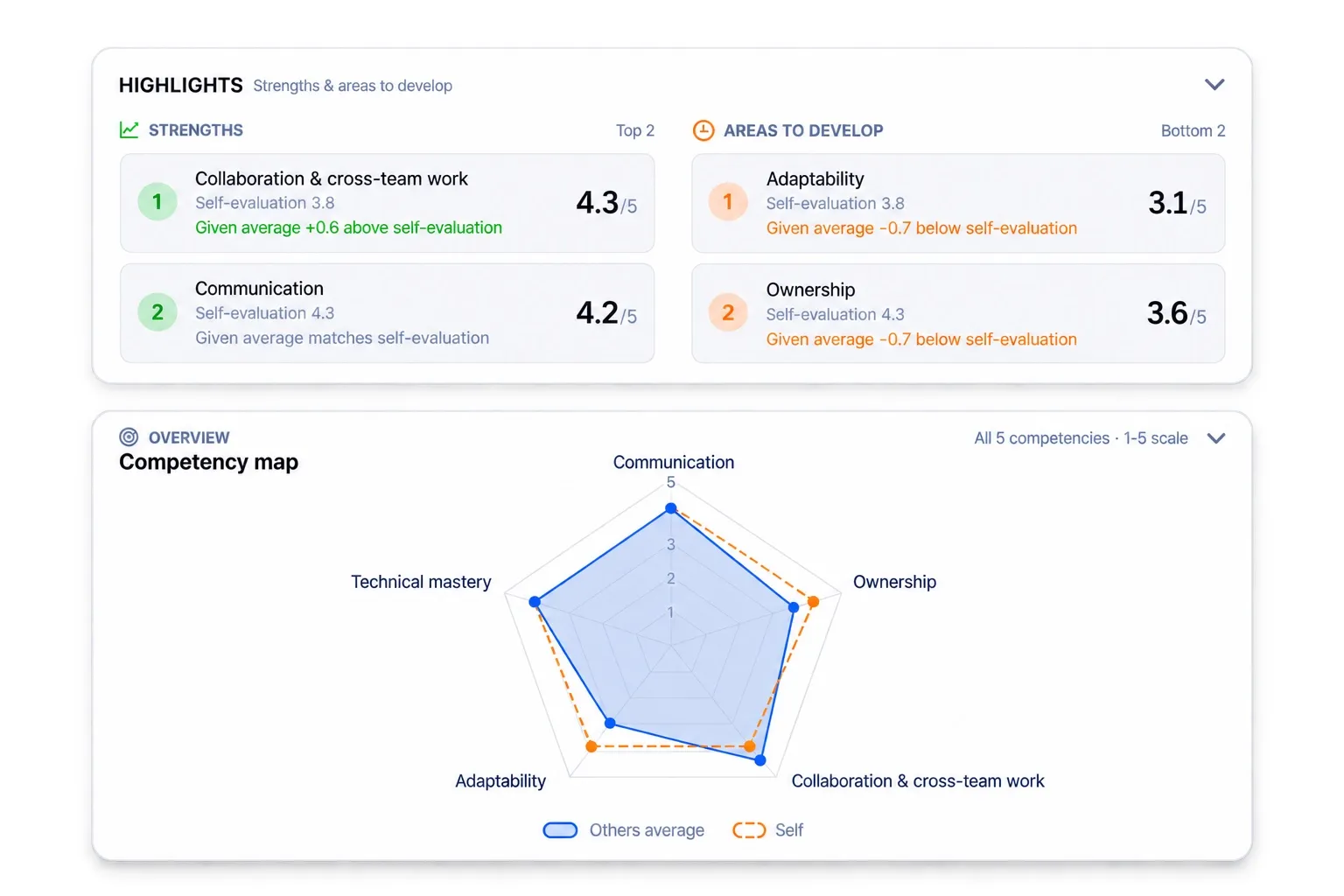
You can do the same by hand: read everything, pick the two strengths and the one or two areas with the most evidence, and bring the specific examples.
Then spend real time on the strengths before you get to the rest. People rush past their strengths to find the criticism, and the conversation goes better when you slow them down. Walking someone through their strengths and growth areas covers how to run that conversation without it turning into a verdict.
Every sentence in this list was written about someone who doesn’t exist, which is the limit of any list. What carries over is the shape: a behaviour, a moment, an effect, and for a growth area, one change. When you’re stuck on an area of improvement, look at the person’s biggest strength and ask where it goes too far. That’s usually where the useful feedback is.
If you’d like those strengths and growth areas collected from five or six colleagues and laid out on one page, you can start free with Lynxify.me and sign in with Google or Microsoft, with no setup call. A shared document and the examples above will also get you most of the way.
What should I put for areas of improvement on an evaluation?
One to three specific behaviours, each with the moment it showed up and a next step. For example: “Deadlines slipped twice this quarter without warning, so flagging risk as soon as I suspect it is my focus for next quarter.” A broad label like “communication” or “time management” on its own gives the reader nothing to measure progress against, so attach a real situation to every area you list.
Is it areas of improvement or areas for improvement?
Both are correct and mean the same thing, and people search for the two phrasings in roughly equal numbers. “Growth areas” and “development areas” are warmer alternatives, and “weaknesses” is the coldest option and the one most likely to make someone defensive. Pick whichever wording your review form already uses and stay consistent.
What are 5 examples of strengths at work?
Five strengths that show up often in 360 feedback: flagging risk early, disagreeing openly in the meeting where the decision is made, closing the loop on work you picked up, explaining complicated things simply, and learning an unfamiliar area quickly. Each one is only useful in feedback when it comes with a moment, such as “you called the payments project at-risk three weeks before the deadline, which let us cut scope instead of slipping the date.”
How do I answer “list 3 key strengths and 3 areas of improvement”?
Choose three strengths other people would recognise and back each one with a recent example. Then choose three areas of improvement you’re already working on, and name the first step you’ve taken for each. Keep every point to a behaviour and a moment. In a job interview the structure is the same, with more weight on the evidence behind your strengths and on the progress you’ve already made.
What are good areas of improvement for managers?
Common ones are holding on to work they should delegate, giving feedback only at review time, making decisions before the team has had a say, and running 1:1s that are status updates. Many of them are a manager’s strengths overdone: the person who is fastest at the work keeps doing it, and the decisive manager decides too early. Write them the same way as any other area, with a moment, its effect, and one change.
Dmytro Shtapauk
Practical tips and experience from top-notch experts