
Rating scale examples for performance and 360 reviews
Read more Questions & Templates

An employee development plan built from 360 feedback picks one or two growth areas from the report, turns each into a behaviour someone could notice, names the support that comes with it, and sets a date to check in and a date to run the 360 again. That’s the whole plan, and it fits on one page.
Most development plans fail in the opposite direction. After a 360, the natural instinct is to write everything down: eight goals, three courses, a reading list. It feels thorough in the meeting, and by the next quarter nobody can remember what was on it. A plan that names two things gets done far more often than one that names eight.
This guide covers what an employee development plan is, how to build one from a 360 report in five steps, a template you can copy, four worked examples, and how to check whether it worked.
Key takeaways
- An employee development plan after a 360 should hold one or two growth areas and one strength to keep using. Plans with more rarely survive the quarter.
- Start from the 360 report: the growth areas several raters agree on, and the gaps between the self-rating and everyone else’s.
- Each growth area becomes a behaviour someone could notice, such as “names the open question in planning meetings”, instead of a trait like “better communicator”.
- Set a check-in four to six weeks out, then re-run the 360 on the same competencies three to six months later to see whether the pattern changed.
- A development plan is about growth. A performance improvement plan is a formal warning. Keep them separate.
An employee development plan is a short written agreement between a person and their manager about what the person will work on, how, and how you’ll both know it’s working. HR teams often call it an individual development plan (IDP). Some companies say professional development plan, and in others it’s a personal development plan (PDP) that the employee writes for themselves. The format matters less than the content: specific growth areas, specific behaviours, a date.
A development plan is a different thing from a performance improvement plan. A PIP is a formal process for someone whose performance is below expectations, with a deadline and consequences. A development plan carries no consequences at all; it’s about getting better at things that matter for the role and the next step. Mixing the two ruins both, and it’s the fastest way to teach a team that 360 feedback is dangerous.
The usual development plan template opens with a question like “What are your career goals?” That’s a hard question to answer well on the spot, and it produces aspirations instead of behaviours. A 360 report gives you something better: evidence from five or six people who work with the person every week.
Three parts of a report feed the plan directly:
If you haven’t read the report closely yet, how to read a 360 feedback report walks through the spread, the gaps and the comments before you get to the plan.
The plan is usually written at the end of the feedback conversation, or in a short follow-up a few days later. Write it with the employee. A plan someone helped write is a plan they own.
Ask the closing question from the conversation: “What’s one thing from this you want to work on?” Then, if there’s a second clear pattern in the report, add it. Stop at two. Add one strength the person should keep using deliberately, because a plan made only of weaknesses reads like a verdict. If you need wording for these, strengths and areas of improvement examples has 30 written as real feedback.
“Communicate better” can’t be checked. “When a decision is unclear in a planning meeting, name the open question before the meeting ends” can. The test: could a colleague tell, by watching for two weeks, whether this is happening? If yes, it’s specific enough.
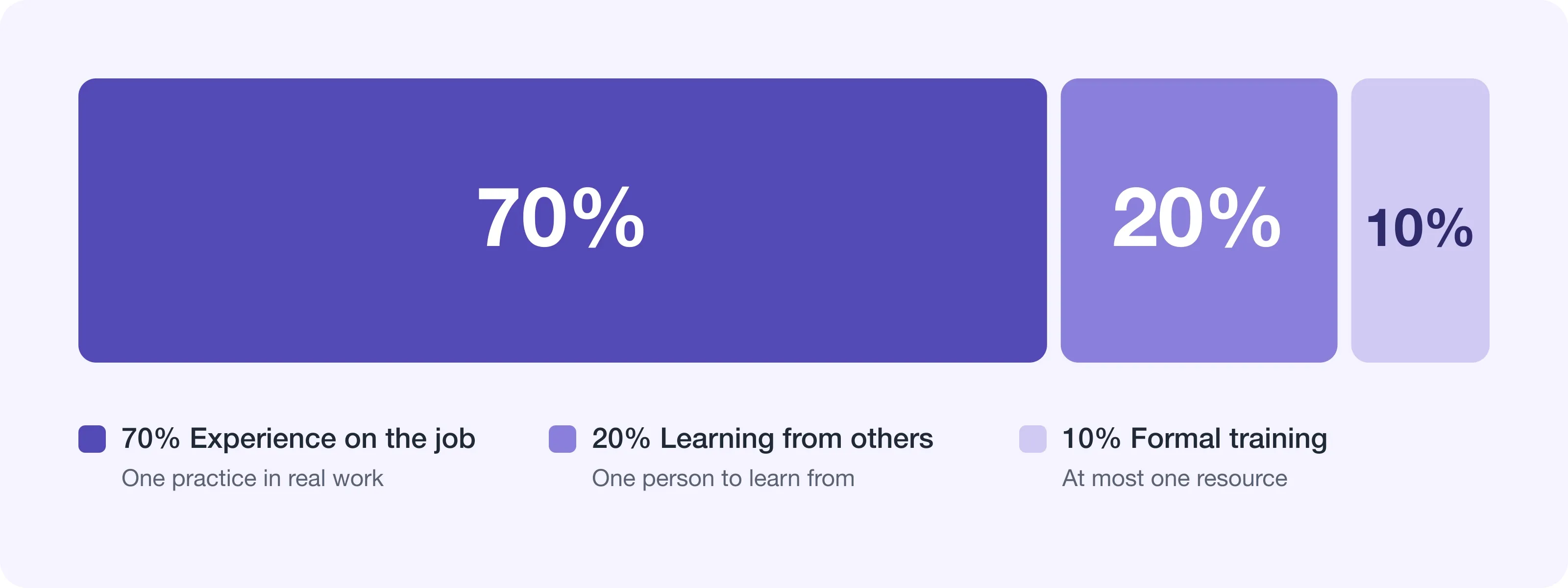
A common rule of thumb in learning and development is 70-20-10: most growth comes from doing the work differently, some from other people, and a little from courses and reading. For a plan after a 360, that usually means one practice in the person’s real work, one person to learn from or get quick feedback from, and at most one resource.
Put a date four to six weeks out in the calendar, and agree what you’ll look at: has the person tried the behaviour, did anyone notice, what got in the way? Without a date, the plan quietly becomes a document from last quarter.
The real test of a development plan is whether the people who gave the feedback see a difference. Run the 360 again in three to six months with the same competencies and, where possible, the same raters. If the gap closed, the plan worked. If it didn’t, you’ve learned something too, and the next plan can be sharper.
This employee development plan template has one row per growth area, plus one row for the strength. Keep it to three rows.
| Growth area or strength | Evidence from the 360 | Behaviour to practise | Support | Check-in | How we’ll know |
|---|---|---|---|---|---|
| Strength to keep using: |
If the plan lives in a message or a shared doc instead of a table, the same thing fits in five lines:
Working on: ___ (from the 360: "___")
What I'll do differently: ___
Help: ___
Check-in: ___ (date)
We'll know it worked when: ___
Store it wherever you keep one-on-one notes, so it’s in front of both of you at every meeting. In Lynxify.me, the manager’s private notes sit next to each person’s 360 report, which is a natural place to keep the plan. Lynxify.me doesn’t track development plans or goals; the template is meant for a doc or your notes.
These are hypothetical, each written the way the template above would be filled in after a 360. Each one turns a growth area into development goals someone could check within weeks.
An individual contributor whose updates arrive late.
A new manager who still does the work themselves.
A senior engineer whose knowledge stays in their head.
Someone who rates themselves lower than everyone else does.
Notice what none of these include: a course, a reading list, or a goal about “being more strategic”. Each one is a behaviour, a date and a way to tell.
Imagine a team lead at a 40-person company who writes plans like these for six people after a 360 round. That’s six one-page documents, about 15 minutes each, written mostly during the feedback conversations. Compare that with the version where each plan has eight goals and nobody opens them again; the short version is the one that leads to a second, better 360.
The check-in is short. Fifteen minutes in a regular one-on-one is enough. Ask three things: what have you tried, what happened, and what got in the way? If the behaviour isn’t happening, the plan is usually too vague or the support isn’t there; fix that before you conclude the person isn’t trying.
The second 360 is where the plan earns its keep. Use the same competencies so the comparison means something. Many tools let you reuse your criteria between rounds, and in Lynxify.me a new round can start from the same competencies as the last one. For the mechanics of running that next round, how to run your first 360 review covers the setup.
A common situation: the second round shows the targeted competency up by half a point, and a new growth area appears that nobody mentioned before. That’s normal and useful. The first plan cleared the most visible issue, and the next plan picks up the new one.
A development plan after a 360 matters less as paperwork than as a promise: we saw something together, you’re going to try something specific, and in a few weeks we’ll look at it again. The template helps you keep that promise short enough to remember. The check-in and the second 360 are what make it real.
If the conversation that comes before the plan is the hard part, how to deliver 360 feedback results covers how to get to that one commitment without the conversation turning into a verdict. And if you want the report, the comments and your notes for each person in one place, you can start free with Lynxify.me and sign in with Google or Microsoft. A shared doc and the template above will also do the job.
How do you write an employee development plan?
Start from evidence, such as a 360 report. Pick one or two growth areas, turn each into a behaviour someone could notice, decide what will help (practice, a person to learn from, a resource), set a check-in date four to six weeks out, and plan to re-run the 360 on the same competencies in three to six months. Write it with the employee, on one page.
What should be in an individual development plan?
For each growth area: the evidence it came from, the specific behaviour to practise, the support that comes with it, a check-in date, and how you will both know it has changed. Add one strength to keep using. Anything beyond that tends to turn the plan into a document nobody reads again.
How many goals should a development plan have?
One or two growth areas, plus one strength to build on. People act on two things; a plan with eight goals usually ends with none of them done. If the 360 surfaced more, keep the rest for the next plan.
What is the difference between a development plan and a performance improvement plan?
A development plan is about growth: it helps someone get better at things that matter for their role and their next step, and it carries no formal consequences. A performance improvement plan (PIP) is a formal process for performance that falls below expectations, with a deadline and consequences if it isn’t met. Keep the two separate, and never use 360 feedback as the evidence for a PIP.
How do you use 360 feedback in a development plan?
Use the report’s growth areas and the gaps between the person’s self-rating and others’ ratings as the starting point, then pick the one or two that several raters agree on. Quote a comment or two as the evidence. After three to six months, run the 360 again with the same competencies, so you can see whether the pattern changed.
How often should you review a development plan?
Have a short check-in four to six weeks after the plan is written, then a fuller look when you re-run the 360, usually three to six months later. Between those, a standing question in your one-on-ones keeps it alive: what have you tried since we last talked?
Dmytro Shtapauk
Practical tips and experience from top-notch experts